The Internet Defense League

Thursday, July 12, 2012

U.S. Debt and the Federal Reserve: A Bit of Much-Deserved Hectoring


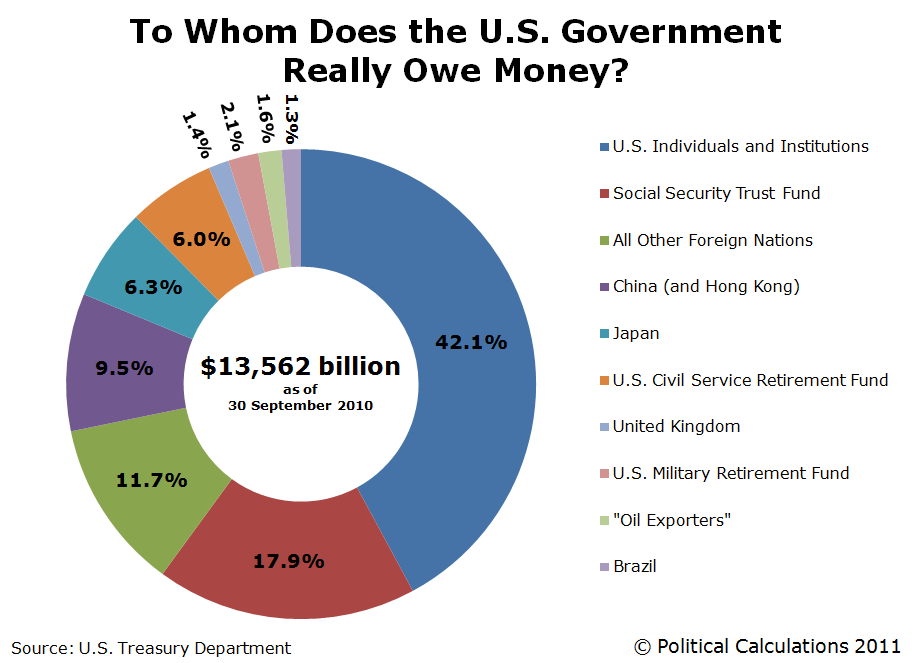
To Whom Does the U.S. Government Really Owe Money?

     The graphic above was retrieved from: http://www.mygovcost.org/2011/03/11/to-whom-does-
     the-u-s-government-really-owe-money/

Isn't this interesting! The government is primarily in debt to, not another country, but to us... Is this surreal? Perhaps. But it may have something to do with the nature of fiat currency- printing money as debt.

By giving bonds from the public treasury to the private Fed to compensate them for putting currency into circulation [why doesn't the public government print its own damn money, you ask? Good question! Woodrow Wilson, to whom I am hopefully not related, signed the F. Reserve Act in 1913 after it made its way through Congress], the Fed is allowed to perpetually collect interest from the American people. Money the federal government spends meeting its obligations to the central bankers is money that cannot be spent meeting its obligations to the citizenry.

Of course, members of the private Fed are theoretically appointed by the government, but how impartial can our government's selections be when we are in debt to the institution in question, whose 13 Federal Reserve Banks are composed largely of private sector individuals like Jamie Dimon with their own vested interests? The short answer: Probably not very impartial.

How much U.S. debt does the Fed own? Certainly not all of it- it cannot be blamed directly for all our ills, although we can be sure it has an indirect role beyond these numbers here (we need look no farther than its lax supervision of reckless bets in the private sector that have seriously impaired our economy)- but a remarkable amount nonetheless.

"We found that as of September 29, 2010, the Federal Reserve held 966 billion dollars of the U.S. national debt in the form of U.S. Treasury Securities or Federal Agency Debt Securities, which represents 16.9% of all U.S. individual or institutional debt holdings, or approximately 7.1% of the total national debt" (go to the the URL given above to see the quote in context).

We must also remember that the Fed is sufficiently free from rigorous supervision that: a) These figures are a year and a half old; b) These figures are provided by the U.S. Treasury Department, the same institution that provides the Fed with a share of the U.S. debt in the form of treasury bonds.

Third-party oversight by, say, citizens? Please, what kind of country do you think we live in, a democracy? Cue the laugh-track here.

Very well, you know what I think on the matter. Comment below, and tell me what you think.

Friday, June 8, 2012

Precision in language, and the politics of science


Science does not speak; only scientists speak. Philosophy does not speak; only philosophers speak. Fields do not exist independent of people. Also, they do not speak with one voice, unless there is only one person in the field in question. Disagreement is a sign that more than one person has committed their subjective minds- their potentially fallible reasoning on the basis of potentially incomplete knowledge, understanding, interpretations, and experience, whatever these may be, to thinking about the same topic. Of course, even speaking of knowledge and experience is potentially a verbal shortcut, a way for imprecision to enter our concepts and make misunderstanding more likely; to speak of our knowledge and experience, singular, is to speak of mental categories into which we place the reality of individual things known and experience. When you can speak of a single category that encompasses multiple real things, or of the real things directly, choose the latter if you want to be as precise as possible in saying what you mean, and the former if you want to be understood by people in general. The important thing is not that you always speak with precision, but that you think with precision, and that requires attentiveness to the nuances of words and their meanings. For instance, the difference between saying ‘science says this,’ and ‘scientists say this.’ Science says nothing, it is neither an entity that can speak for itself, nor is it singular. It is a category for a method for understanding reality, and the multiple, interconnected fields of study in which this method is used; the method is one created and applied by human beings. The method and the fields in which it is applied are valuable to human beings for the increased accuracy of our understanding of the physical world and universe, but they are inextricable from us. Speaking of them as if they were is to suggest they are singular, monolithic and above human disputes, none of which are accurate.

Wednesday, March 14, 2012

Human nature and annoyance

As far as I can see, human beings spend their lives rolling their eyes about how stupid they think other people are. Perhaps it would be more sensible to agree that, yes, people are goofy, flawed, and annoying, and stop being surprised or annoyed by what is the case? There is no reason for surprise at what has always been, or to give in to feelings of annoyance when the source of those feelings cannot be avoided, unless you are willing to become a hermit (which you probably aren’t). Yet, it seems to be human nature to be annoyed at other people’s human nature! Particularly when one is in a bad mood, of course.

Monday, March 12, 2012

The Android God

Our society is so obsessed with complex tools—what else is ‘technology’?—that the role of human face-to-face interactions has been eclipsed by the enthusiastic adoption of electronic intermediaries. One wonders if we could appreciate a naturalistic conception of god, if we were presented with it afresh, rather than as received cultural mythology. Indeed, if god is created in the image of man, one wonders if god is actually an android—or spends so much time with his supercomputer of the divine (accessed by the Holy Spirit of wireless) that he might as well be. After all, do we not make god in our own image, and then say that it is the other way around—that he made us in the image of himself? Perhaps god made us primitive, so long ago, because he himself was primitive; or, perhaps we made god primitive, because we were ourselves. Either way, we are different now—not because human nature is different, but because we are more than human, we are also cultural creatures—and our cultures are overrun with neon gods. Somehow we still give the worship of our lips, out of incongruous habit, to a cultural artifact. After all, the correspondence of Christianity to our society, our way of life, our purposes, our culture, is utterly gone. We do not live in Palestine, 200 C.E., nor in Europe of the Dark Ages.  Either we should remake god in the image of how we are now, saying that he made us to make our computers extensions of ourselves, and to anthropomorphize our iPhones—this point at which the integration of technology into our lives leaves only its integration into our bodies—or call it quits with metaphysics. Shall we worship the neon gods of our distraction with our words as well as our eyes? Or are these, too, false idols?

Friday, March 9, 2012

A few words on love

Love each other when you can, accept each other when you can’t, and tolerate each other when you can’t do more than that. We cause each other so much misery because we dip our toes into tolerance, rather than leaping into love without looking. Everyone has flaws or ugliness, whether you can see them or not, and all people are sometimes annoying, even when you start with love. How much more annoying are those we merely try to tolerate, rather than try to love! To only be willing to love the perfect is to set yourself up for never loving at all. Are you letting someone else’s idea of perfect be the enemy of what is good for you- are you holding the good up to someone else’s mirror, rather than before your own eyes? Try starting with love, and moving down from that when you must- rather than starting with something less than tolerance, and moving up from that if you can. The former is a better way to live. Easier said than done, but isn't everything?- at least, everything worth doing?

Wednesday, February 29, 2012

Financial crisis, reckless banking, and fiat currency

The following was written in 1991:

“The largest banks know, however, that they are literally 'too big to fail' and can count on a helping hand from government if the worst comes to the worst. America's political leaders would step in to prevent the crash of a major financial institution on the grounds that it could set off a lethal chain reaction culminating in widespread disaster. ... Thus, in yet another intriguing but ominous irony of history, 10 years of ultra-liberalism have resulted in a US financial system whose future may only be assured with the help of federal government handouts”

~p.61 of Capitalism Against Capitalism, by Michel Albert.

Albert was the CEO of a French insurance company. This is interesting, because one of the issues with the sub-prime mortgage crisis was the failure of AIG due in part to its insuring of credit default swaps. Insurance companies had a role, along with regulatory agencies, brokerage firms, and governments themselves, in making banks feel safe about the bets they were playing by the process of securitization, and thereby content to continue their game of economic roulette. The world is not discrete pieces or discrete entities; it is connections.

I retrieved this quote from the wiki on 'Rhine Capitalism,' as contrasted with the term 'Anglo-Saxon Economy.' Note that neither term seems to have acquired very wide currency. However, given that fiat or credit money is issued as debt and thereby given worth only by economic expansion that will represent the value presupposed by each additional dollar put into circulation, our currency isn't wholly reliable either. Like a gambler, we are placing our bets not on the present, but on the future. Isn't that what printing money as a loan to oneself is? Betting that, in the future, you will have the value you lack today? Perhaps that is why Americans are more religious than other nations; we love our money, and it tells us to have faith in God that our currency won't collapse. All you can do, my friend, is have a little faith; but complacency will do just as well.

Monday, December 19, 2011

Party politics and third parties

Party politics is the source of a great deal of pettiness, small-mindedness, and irrational dislike. Period. Would the ascendancy of a third party change this dynamic? Maybe not, but (depending on which third party) this could bring more diversity of ideas into politics and represent the people more effectively. I’m voting third-party this coming election for a reason, and so should you. Whatever your reason might be, vote for the party that represents your own views best, rather than the party that compromises on your views most effectively, and sacrifices your principles with the greatest gain. If more people voted the way they believed, rather than the way that seemed most expedient, the two-party system would not have the stranglehold on government and political discourse that it does at present, and people would no longer see voting as a choice between the Demoblicans (or Demublicans, if you prefer!) and the Republicrats.