The following is by no means comprehensive, but it is intended to give a sense of some of the influences on NCLB (decades of national concern with the quality of education in the U.S., the supposed miracle in the schools of Texas in the 1990s), and some of its effects. I do not go into depth on the specifics of its implementation.
National Policy Climate
No
Child Left Behind (NCLB) is a 2002 reauthorization of a 1965 piece
of legislation called the Elementary and Secondary Education Act. Though NCLB was such a shock to the national education system that it was more like a revolution than a reauthorization, it nevertheless drew on concerns that had existed for decades. The difference was not the aim, but the implementation.
The Elementary and Secondary Education Act, in its original form, was motivated by the recognition of an achievement gap in poor schools.
Federal money, under Title I, was used to supplement state funding for
schools. When a school was identified as having both high poverty and
low achievement, a calculation would be done to determine how
much Title I money would be given to that school (9/4/12 lecture notes, on an education class at Ohio University).
By 1980, there was
plenty of evidence that the achievement gap was not closing, and was in
some areas getting worse. The 1983 report A
Nation at Risk led to increased concerns among teachers, politicians,
and the public about the state of public schooling in the U.S. (Toppo,
2008). A desire to find top-down, evidence-based solution to academic
woes has only mounted since. In other words, NCLB did not come out of
the blue; it addressed long-standing concerns in predictably
technocratic, quantification-oriented ways.
"Where all the children are above average" (Garrison Keillor)
NCLB expects that all
students- literally, 100%- score 'proficient' (average) or higher on standardized tests by 2014. This suggests a
basic misunderstanding of what an average is. Mandating that everyone be at or above average is statistically impossible, and that cannot be changed by any tweaking of the means or time allotted for achieving this goal. When there is a
range of performance levels, the average of those performance levels
will be higher than some, and lower than others.
You cannot always bring desired outcomes into existence by demanding
that they occur, particularly when the desired outcome is impossible by
definition.
A Miracle in Texas?
Many people may not be aware that NCLB was based on
"The Texas Miracle" and the schools of Houston in particular. That the
nation's schools came to be modeled on those of Houston was
unsurprising, given that the superintendent of Houston's schools, Rod
Paige, was named secretary of education by George W. Bush. "Paige... had
instituted a policy of
holding principals accountable for how their students did. Principals
worked under one-year contracts, and each year, the school district set
strict goals in areas like dropout rates and test scores. Principals who
met the goals got cash bonuses of up to $5,000, and other
perks. Those who fell short were transferred, demoted or forced out."
(Leung, 2009). Investigative reporting by 60 Minutes found that the impressive statistics of high test scores and low drop out rates were, in effect, falsified (Leung, 2009). Later, similar concerns about honesty on the part of administrators and teachers would come to light with NCLB as well.
A
common complaint about NCLB is the tendency of teachers to teach to
standardized accountability tests. According to Walt Haney of Boston
College, who spent over two years on an extraordinarily comprehensive
article about this supposed miracle, the same tendency was found in
Texas after the introduction between 1990 and 1991 of the Texas
Assessment of Academic Skills (TAAS). "In the opinion of educators in
Texas, schools are devoting a huge amount of time and energy preparing
students specifically for TAAS, and emphasis on TAAS is hurting more
than helping teaching and learning in Texas schools, particularly with
at-risk students, and TAAS contributes to retention in grade and
dropping out" (Haney, from the abstract). There is also evidence of
negative effects of educational policies used in Texas on minorities
(higher rates of failure, repeating the same grade, dropping out).
Further, TAAS may be neither reliable or valid, and increases in TAAS
scores have actually coincided with decreases in scores on a
college readiness test. "Between 1994 and 1997, TAAS results showed a
20% increase in the percentage of students passing all three exit level
TAAS tests (reading, writing and math), but TASP (a college readiness
test) results showed a sharp decrease (from 65.2% to 43.3%) in the
percentage of students passing all three parts (reading, math, and
writing)" (Haney, abstract).
Textbooks, Tests, and Motivation
One of the first
expectations of good research about even a subject of insignificance is
that the student use multiple sources. No single source should have a
monopoly on discourse- it is
fundamentally contrary to intellectual integrity. Yet, whole subjects,
taught for the 180 days of a school year, apparently do not
merit the same extent of concern for variety of perspectives as a five-page research paper
completed in a couple hours. In many classrooms, teachers can tell their students 'open your books' or 'turn to the
text,' and know that they will understand what they are talking; this suggests that everyone in that classroom takes
for granted that only one book will be used there. Why is this? According to many
teachers, it is because
the textbook they use includes everything the students will be tested
on.
It is no wonder that there are concerns about NCLB
narrowing curriculum, and diminishing the enthusiasm of teachers. Has
anyone who has truly enjoyed thinking about things and learning things
ever been motivated by wanting to prove themselves on an impersonal
Scantron? I think motivation to learn is found in
our curiosity about the material, and our connections to our teachers.
If this is the case, then it is surely a poor indicator for the future
of education that testing regimes encourage a view of education more
preoccupied with tests than either interesting information, ideas, or
discussion. NCLB is an impoverishment of education, rather than an
enriching of it.
Reliance on textbooks is also problematic because it presents a unified, rather than a contested, view of the realities discussed. Do teachers who rely on textbooks care about non-hegemonic perspectives (e.g., perspectives that are not Eurocentric, patriarchal, classist, racist, and so on)? Some of them do, of course. Yet, they trust the authors of the textbooks they use to provide a neat cross-section of these views- a neatness which is often reductionist and marginalizing, and communicates none of the passion that is in them- and expect that this will suffice. This is naive, and a poor example to those they teach; not only are textbook authors fallible human beings, but reality is not so neatly pinned down. No one has a monopoly on reality, so why give someone a monopoly on the parameters of discourse within your classroom?
Unintended Consequences
One of the most basic, but
undervalued, aspects of good decision-making is the regard for
unintended consequences. Because it is hard to know the full
ramifications of any course of action until some time has passed, it is
wise to wait and see before attempting to make a would-be objective
statement about whether or not that course of action is desirable; and,
because it takes time for consequences to unfold, it is best to
institute changes slowly and steadily, rather than all at once. (Perhaps
human social structures, like human bodies, can undergo 'shock,' and
the associated unpleasant and disorienting affects- certainly, many
individual teachers felt shocked by NCLB!) Such prudence was not shown
either in waiting to deem the educational reforms in Texas miraculous,
nor in deciding to scale them up to the nation as a whole. Now that time
has passed, it is clear that many of the concerns had about NCLB- for
instance, the propensity to motivate dishonest behaviors by some
teachers and administrators (for instance, see
http://fairtest.org/nclb-boosts-temptation-cheat)- were evident, first,
in the Houston schools on which it was based.
Citations
Leung,
R. (2009, February 11). The 'texas miracle'. CBS News. Retrieved from
http://www.cbsnews.com/stories/2004/01/06/60ii/main591676.shtml
Toppo, G. (2008, August 1). 'Nation at risk': The best thing or the worst thing for education?. USA Today. Retrieved from http://usatoday30.usatoday.com/news/education/2008-04-22-nation-at-risk_N.htm
Walt, H. (2000). The Myth of the Texas Miracle in Education. Education Policy Analysis Archives, 41
Sunday, December 2, 2012

Thursday, September 6, 2012
On Quality: In Our Things, and In Our Lives
My can opener broke, and because
the ones sold at the stores (like the one presently in my trash) are crap, I
looked online, and found people rhapsodizing about the merits of an apparently
quality can opener. What are they doing with their lives? Well, I'm writing
about looking for one, so probably the same thing as me. I am not sure whether
it is a remark on our consumerism, or on the old love of good quality and
design- the human fetish for things that endure, even if it is just a household
object.
Ironically, planned obsolescence of
consumerism makes good quality and design more rare for common products, rather
than less. Consumerism is not the democratization of design, but about the
elitism of quality- in which quality is not just pricey (it has probably always
been), but a price we are trained to be unwilling to pay. Why are we trained
this way? Because paying for quality means paying more, at least in the
short-term.
It is that way with food, too; the
average American household spent considerably more money on food (with the
appropriate conversions for inflation, and such), as recently as the 1950s and
1960s, than is the case today. They were getting better-quality food, and there
was less obesity; now, we take for granted that good-quality food is for the
rich, and have a trained aversion to eating right as something that is snooty,
tedious, pretentious. Yet, look at our healthcare costs- everything has
consequences. There may or may not be a free lunch, but there is certainly no such thing as a cheap Big
Mac.
There is an elitism of quality, in
material things- and a leveling of taste and lowering of expectations among
everyone who is not willing to stand out, and claim the elite status of healthy
living or durable goods as their own. To do so, our society implies, is to
nominate ourselves as 'better' than other people, rather than merely sensible,
and enlightened in self-interest. This is strange; isn't self-interest the
motivation that supposedly drives our decisions in those reductionist economic
models? Isn't it a good thing, and supposed to be the exception rather than the
rule?
Only if you're blind, deaf, and
dumb. Advertising, egoism, and impulse-buying work contrary to our individual
best interests on a daily basis, and keep our economy afloat on a sea of people
made insecure and shallow, systematically, by the 24-7 psychological artillery
barrage of the media- liquefying the human will into pourable form. Even people who can afford better have been
trained not to choose better, both with individual goods, and with their lives
is general.
Is it that we love things so much that
we have to make them as low-quality as possible- so we have an excuse to buy
them again, or buy more of them? No, I think most of us are systematically
trained to buy the cheapest things in the name of 'good deals,' so we can be
sold the same can opener three times- and trained to buy the cheapest food, so
we can be sold more of it, with an angioplasty on the side. So often, good
quality ends where good deals begin; so often, self-reliance and contentment
are ruined by our learned acquiescence to a society with a systematically
impaired approach to the relation of ourselves to each other, and ourselves to
our things. Can we unlearn that? Yes, if we want to.
A good quality can opener is a good
thing, but there are far greater goods than the goods sold in stores, and far
greater quality than quality in design; the greatest of all quality is in
ourselves, and in our capacity, but it is not a default. We can make it daily,
there is no other way to make it. We make it by our efforts and our discipline,
by our selective gaze, by the care of our choices. A good life does not happen
by accident or by accessories. It happens by approaching our lives as stewards,
rather than as owners; as gardeners, rather than as rabbits rummaging for what
we can get. Let us focus on a good life over good things, and review our
choices more than we review our products. More than we wonder what else we need
materially, let us wonder how we can realize great things in daily life. It is
that which we need; more self-reliance, spiritually, and more simplicity,
materially. These things can be chosen and embraced, and what higher quality is
there than such a choice, such an embrace?
To riff on Zen and the Art of
Motorcycle Maintenance: The real can you are trying to open is yourself.
How can you use yourself to open yourself? You are not both at the same time,
but you are one and then the other. Be whole and entire, moment by moment; know
that the person you work on today is furnished by who you were yesterday. As
William James would have it, introspection is immediate retrospection; we do
not observe ourselves directly, but in hindsight, through the memories of the
states of mind that came before.
Know that you are only one and whole
a moment at a time, and you will find more peace if you can only remain in the moment
more often. Make habits that will help you prepare for the future without
having to consider them. Do the right things without a second thought, and you
will make the future a good one, with less worry. Until they are habit,
mindfulness and openness are a daily effort; and when they are part of your
daily life, may they endure and grow. These qualities- endurance and
growth- are the greatest marks of worth. Do not only maintain the good, but change
it into a greater good. Adapt constructively, and take the next good
step.
Contrary to this flexible and adaptive approach to reality, we find ideology; a rigidity so great that life in any fresh or vibrant sense is absent. In particular, I think a reactionary,
stultifying form of conservatism fossilizes the good. Not only does it fail to
preserve the most enduring aspects of the past in any living sense, it
also kills what is left with its mindless clinging to the recent past, and sometimes
to what is worst in it. No, do not be a keeper of the letter, long after the
spirit has fled; do not guard a torch that was put out centuries ago, unless
you are going to relight it. Dare you relight it? Do not be a conservative in the usual sense, but
do not be a liberal in the usual sense either. Critique the structures of power, but live what you feel the world should be. Live in the moment, not without structure, but with habits and attitudes you established in
days when you were not in the moment, with your head full of history and memory; and make decisions about how to live, in part, on the basis of prospective futures, and what you think is sustainable for yourself, your society, and the world as a whole.
Most days, you live it out, rather than second-guessing it- ideology recognizes this, but its habits of thought and action are not chosen by you, to fit your life, but chosen by default of your familiarity with them. Live in the moment, so you are there to pay attention to other people; emphasize compassion and respect in each moment as primary, and other principles as secondary. An ethics that involves sacrificing compassion or respect in the name of principle is not much of an ethics; we see this whenever the ends supersedes the means, however moral those ends may seem. Also, live in the moment so you are there to step into the opportunities you cannot predict, and attentive to each that comes; this way, you will not be taken by surprise. We must be aware of these questions of value and expectation, for they govern our lives.
Do we base our values in the assumption that values are (a) Inherent qualities (or, perhaps more accurately, the realization that consequences are inextricable from the things whose attributes are necessary for those consequences continuing), or (b) Qualities divorced from things- consequences, without loyalty to the source of those consequences? How we answer this question provides the template for our approach to life and other people. 'a' is associated with consistency, and a sufficiency mindset, acceptance of things as they are; 'b' is associated with the shifting of instrumental reason- always trying to change how things will be, and align the consequences differently.
Expectations, similarly, become self-fulfilling prophecies- we do not do what we think we cannot. We, today, are the foundations of our tomorrows, and part of who we are is what we think. We must also be aware that expecting things is a way of stepping outside of the moment. Expectations and waiting can erode us, and take away from our lives.
Stepping out from where you are and examining your assumptions (including your expectations) can help you gain perspective, and evaluate your priorities and habits to see if you wish to change; but, in most of life, it is best to inhabit your own moments from within them, as an actor, rather than as an audience. Live fully from within your skin and state of mind, rather than imagining yourself outside them- that always has something of an artifice to it, and precludes spontaneity. Einstein said that few live with their own eyes and feel with their own hearts. I.e., people take their seeing and feeling second-hand. And, in this case, I am taking the words of someone else; but such borrowing is okay, I think, as long as they fit your experience and are useful to your attentiveness, rather than to your sleep. Insofar as you can, take your own for your own; step into yourself, rather than from yourself, and inhabit your own being.
Most days, you live it out, rather than second-guessing it- ideology recognizes this, but its habits of thought and action are not chosen by you, to fit your life, but chosen by default of your familiarity with them. Live in the moment, so you are there to pay attention to other people; emphasize compassion and respect in each moment as primary, and other principles as secondary. An ethics that involves sacrificing compassion or respect in the name of principle is not much of an ethics; we see this whenever the ends supersedes the means, however moral those ends may seem. Also, live in the moment so you are there to step into the opportunities you cannot predict, and attentive to each that comes; this way, you will not be taken by surprise. We must be aware of these questions of value and expectation, for they govern our lives.
Do we base our values in the assumption that values are (a) Inherent qualities (or, perhaps more accurately, the realization that consequences are inextricable from the things whose attributes are necessary for those consequences continuing), or (b) Qualities divorced from things- consequences, without loyalty to the source of those consequences? How we answer this question provides the template for our approach to life and other people. 'a' is associated with consistency, and a sufficiency mindset, acceptance of things as they are; 'b' is associated with the shifting of instrumental reason- always trying to change how things will be, and align the consequences differently.
Expectations, similarly, become self-fulfilling prophecies- we do not do what we think we cannot. We, today, are the foundations of our tomorrows, and part of who we are is what we think. We must also be aware that expecting things is a way of stepping outside of the moment. Expectations and waiting can erode us, and take away from our lives.
Stepping out from where you are and examining your assumptions (including your expectations) can help you gain perspective, and evaluate your priorities and habits to see if you wish to change; but, in most of life, it is best to inhabit your own moments from within them, as an actor, rather than as an audience. Live fully from within your skin and state of mind, rather than imagining yourself outside them- that always has something of an artifice to it, and precludes spontaneity. Einstein said that few live with their own eyes and feel with their own hearts. I.e., people take their seeing and feeling second-hand. And, in this case, I am taking the words of someone else; but such borrowing is okay, I think, as long as they fit your experience and are useful to your attentiveness, rather than to your sleep. Insofar as you can, take your own for your own; step into yourself, rather than from yourself, and inhabit your own being.
Each
moment, its actions and its thoughts, is a preparation for something, or a
prelude to something we have not considered. What are you preparing for? What
am I preparing for? What is in today that is the prelude for our tomorrow? Let us live our own lives with integrity and self-respect, centered in ourselves; surely that is a preparation for a better future than looking to other people for our cues, when the purposes that justify those cues for them may not match our own. Certainly, the kind of foundation we provide for ourselves is largely learned, and taught by what is common among those around us; yet, this does not mean the people presently around us wholly determine our lives. With the glimmer of a rare or read-about example, sometimes we begin to see differently, and thereby to live differently as well, than the overwhelming majority of people we know. It is still an example, but a minority example; we can choose to live by the example that is different from the rest.
We teach ourselves to live by learning how to process our experience. We first learn how to process what we experience from other people (e.g., explanatory styles, the mental templates we use to make judgments, etc.), yet we can learn how to live on the basis of conclusions we draw from attentiveness to our experience itself, and paying attention to what is in it. We are never without influence, but we can learn to choose our influences. The process we bring to our seeing may be the same as that of another person, or ten million other people, but our sights are our own; our experiences are similar, but not the same. Let us live our values, expect less, and make better habits of thought and action. When we think without the script of our habitual thoughts, let us think based on what we know, or think we do. Let us live on the basis of a less explicit script, a barer script- a more open-ended way of approaching life in our thoughts and actions- one that has fewer and less specific expectations, but ones that are carefully selected. Expectations of ourselves, first, and expectations of other people, second. Only then do we have the structure in which improvisation and spontaneity is fruitful and possible.
It seems to me that a mindful life is the highest quality there is- but only when we live it, rather than talk about it. In the meantime, trying to transmute our words into actions, habit is so much of our nature. Of course, I am not saying we are not constrained within a range of possible outcomes by our nature as well, for we are; but we can only test the limits of that range by entertaining the possibility that the envelope of our freedom can always be pushed open a little wider, that we can choose things that enhance our freedom, piece by piece. When we say, 'that is my nature, it is just how I am,' we overestimate the inevitability of that state of affairs or state of mind continuing. And surely, the conviction that something is impossible is the end of possibility.
We teach ourselves to live by learning how to process our experience. We first learn how to process what we experience from other people (e.g., explanatory styles, the mental templates we use to make judgments, etc.), yet we can learn how to live on the basis of conclusions we draw from attentiveness to our experience itself, and paying attention to what is in it. We are never without influence, but we can learn to choose our influences. The process we bring to our seeing may be the same as that of another person, or ten million other people, but our sights are our own; our experiences are similar, but not the same. Let us live our values, expect less, and make better habits of thought and action. When we think without the script of our habitual thoughts, let us think based on what we know, or think we do. Let us live on the basis of a less explicit script, a barer script- a more open-ended way of approaching life in our thoughts and actions- one that has fewer and less specific expectations, but ones that are carefully selected. Expectations of ourselves, first, and expectations of other people, second. Only then do we have the structure in which improvisation and spontaneity is fruitful and possible.
It seems to me that a mindful life is the highest quality there is- but only when we live it, rather than talk about it. In the meantime, trying to transmute our words into actions, habit is so much of our nature. Of course, I am not saying we are not constrained within a range of possible outcomes by our nature as well, for we are; but we can only test the limits of that range by entertaining the possibility that the envelope of our freedom can always be pushed open a little wider, that we can choose things that enhance our freedom, piece by piece. When we say, 'that is my nature, it is just how I am,' we overestimate the inevitability of that state of affairs or state of mind continuing. And surely, the conviction that something is impossible is the end of possibility.
When I'm not writing, I sometimes open
cans. With the right habits, and the right tool, it is second nature. But life, as we find it in ourselves and our surroundings, is the real can we are trying to open. Mindfulness- a carefully used, incisive awareness, located in the present- is the quality tool we need if we wish to open it. Conveniently enough, we find both life and mindfulness in the same place, and that is precisely where we are. In that sense, they are both durable indeed; they last as long as our present. Our time may seem limited when we step outside the present, but timeless when we step into it. Knowing when to step into it and when to step out of it, so you can check your steps- now, that's quality.
Thursday, July 12, 2012
U.S. Debt and the Federal Reserve: A Bit of Much-Deserved Hectoring
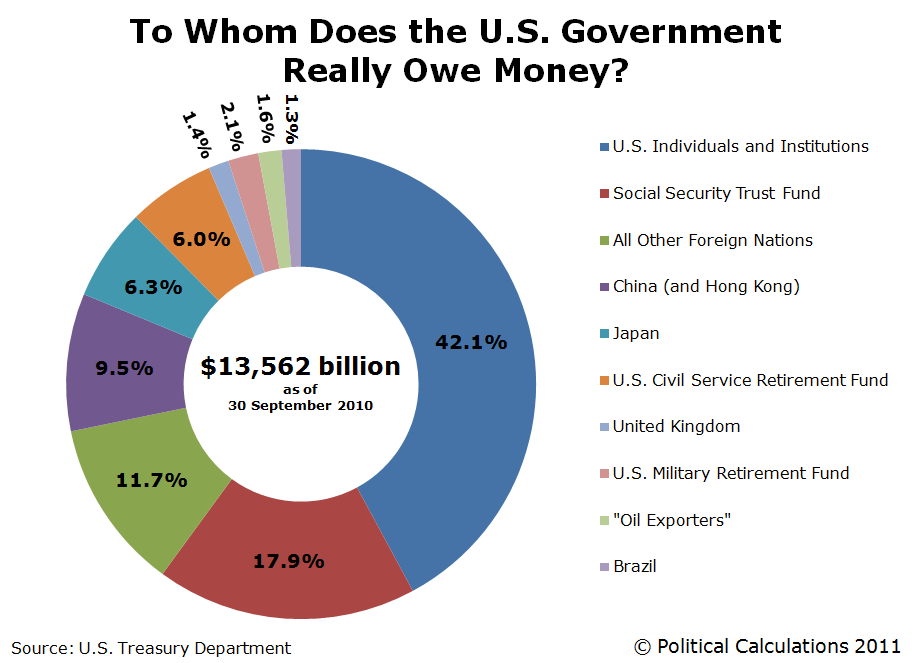
The graphic above was retrieved from: http://www.mygovcost.org/2011/03/11/to-whom-does-
the-u-s-government-really-owe-money/
Isn't this interesting! The government is primarily in debt to, not another country, but to us... Is this surreal? Perhaps. But it may have something to do with the nature of fiat currency- printing money as debt.
By giving bonds from the public treasury to the private Fed to compensate them for putting currency into circulation [why doesn't the public government print its own damn money, you ask? Good question! Woodrow Wilson, to whom I am hopefully not related, signed the F. Reserve Act in 1913 after it made its way through Congress], the Fed is allowed to perpetually collect interest from the American people. Money the federal government spends meeting its obligations to the central bankers is money that cannot be spent meeting its obligations to the citizenry.
Of course, members of the private Fed are theoretically appointed by the government, but how impartial can our government's selections be when we are in debt to the institution in question, whose 13 Federal Reserve Banks are composed largely of private sector individuals like Jamie Dimon with their own vested interests? The short answer: Probably not very impartial.
How much U.S. debt does the Fed own? Certainly not all of it- it cannot be blamed directly for all our ills, although we can be sure it has an indirect role beyond these numbers here (we need look no farther than its lax supervision of reckless bets in the private sector that have seriously impaired our economy)- but a remarkable amount nonetheless.
"We found that as of September 29, 2010, the Federal Reserve held 966 billion dollars of the U.S. national debt in the form of U.S. Treasury Securities or Federal Agency Debt Securities, which represents 16.9% of all U.S. individual or institutional debt holdings, or approximately 7.1% of the total national debt" (go to the the URL given above to see the quote in context).
We must also remember that the Fed is sufficiently free from rigorous supervision that: a) These figures are a year and a half old; b) These figures are provided by the U.S. Treasury Department, the same institution that provides the Fed with a share of the U.S. debt in the form of treasury bonds.
Third-party oversight by, say, citizens? Please, what kind of country do you think we live in, a democracy? Cue the laugh-track here.
Very well, you know what I think on the matter. Comment below, and tell me what you think.
Friday, June 8, 2012
Precision in language, and the politics of science
Science does not speak; only scientists speak. Philosophy does not speak; only philosophers speak. Fields do not exist independent of people. Also, they do not speak with one voice, unless there is only one person in the field in question. Disagreement is a sign that more than one person has committed their subjective minds- their potentially fallible reasoning on the basis of potentially incomplete knowledge, understanding, interpretations, and experience, whatever these may be, to thinking about the same topic. Of course, even speaking of knowledge and experience is potentially a verbal shortcut, a way for imprecision to enter our concepts and make misunderstanding more likely; to speak of our knowledge and experience, singular, is to speak of mental categories into which we place the reality of individual things known and experience. When you can speak of a single category that encompasses multiple real things, or of the real things directly, choose the latter if you want to be as precise as possible in saying what you mean, and the former if you want to be understood by people in general. The important thing is not that you always speak with precision, but that you think with precision, and that requires attentiveness to the nuances of words and their meanings. For instance, the difference between saying ‘science says this,’ and ‘scientists say this.’ Science says nothing, it is neither an entity that can speak for itself, nor is it singular. It is a category for a method for understanding reality, and the multiple, interconnected fields of study in which this method is used; the method is one created and applied by human beings. The method and the fields in which it is applied are valuable to human beings for the increased accuracy of our understanding of the physical world and universe, but they are inextricable from us. Speaking of them as if they were is to suggest they are singular, monolithic and above human disputes, none of which are accurate.
Wednesday, March 14, 2012
Human nature and annoyance
As far as I can see, human beings spend their lives rolling their eyes about how stupid they think other people are. Perhaps it would be more sensible to agree that, yes, people are goofy, flawed, and annoying, and stop being surprised or annoyed by what is the case? There is no reason for surprise at what has always been, or to give in to feelings of annoyance when the source of those feelings cannot be avoided, unless you are willing to become a hermit (which you probably aren’t). Yet, it seems to be human nature to be annoyed at other people’s human nature! Particularly when one is in a bad mood, of course.
Monday, March 12, 2012
The Android God
Our society is so obsessed with complex tools—what else is ‘technology’?—that the role of human face-to-face interactions has been eclipsed by the enthusiastic adoption of electronic intermediaries. One wonders if we could appreciate a naturalistic conception of god, if we were presented with it afresh, rather than as received cultural mythology. Indeed, if god is created in the image of man, one wonders if god is actually an android—or spends so much time with his supercomputer of the divine (accessed by the Holy Spirit of wireless) that he might as well be. After all, do we not make god in our own image, and then say that it is the other way around—that he made us in the image of himself? Perhaps god made us primitive, so long ago, because he himself was primitive; or, perhaps we made god primitive, because we were ourselves. Either way, we are different now—not because human nature is different, but because we are more than human, we are also cultural creatures—and our cultures are overrun with neon gods. Somehow we still give the worship of our lips, out of incongruous habit, to a cultural artifact. After all, the correspondence of Christianity to our society, our way of life, our purposes, our culture, is utterly gone. We do not live in Palestine, 200 C.E., nor in Europe of the Dark Ages. Either we should remake god in the image of how we are now, saying that he made us to make our computers extensions of ourselves, and to anthropomorphize our iPhones—this point at which the integration of technology into our lives leaves only its integration into our bodies—or call it quits with metaphysics. Shall we worship the neon gods of our distraction with our words as well as our eyes? Or are these, too, false idols?
Friday, March 9, 2012
A few words on love
Love each other when you can, accept each other when you can’t, and tolerate each other when you can’t do more than that. We cause each other so much misery because we dip our toes into tolerance, rather than leaping into love without looking. Everyone has flaws or ugliness, whether you can see them or not, and all people are sometimes annoying, even when you start with love. How much more annoying are those we merely try to tolerate, rather than try to love! To only be willing to love the perfect is to set yourself up for never loving at all. Are you letting someone else’s idea of perfect be the enemy of what is good for you- are you holding the good up to someone else’s mirror, rather than before your own eyes? Try starting with love, and moving down from that when you must- rather than starting with something less than tolerance, and moving up from that if you can. The former is a better way to live. Easier said than done, but isn't everything?- at least, everything worth doing?
Subscribe to:
Posts (Atom)